
John Kincaid and the burning of Gauley Bridge
#John-Kincaid #Matthew-Kincaid
As reported in the Niles' weekly register, Volume 31 (The Niles Register was published in
Baltimore, MD.) The burning seemed to occur July 11, 1826. It is possible that John lost land according to the following.
The first bridge on the James River and Kanawha Turnpike here was begun in 1823 and completed in April 1825. During construction, four acres of a local family’s land at one end of the bridge was condemned for abutments and a tollhouse. Angered by the loss of the property, the head of the family and one of his sons burned the bridge in July 1826. They were tried, convicted, and imprisoned for the crime. In October 1830, another son applied to the turnpike superintendent for a contract to maintain parts of the road on either side of Gauley Bridge. Because the superintendent suspected that he had been in collusion with his father and brother to burn the first bridge, he did not get the job.
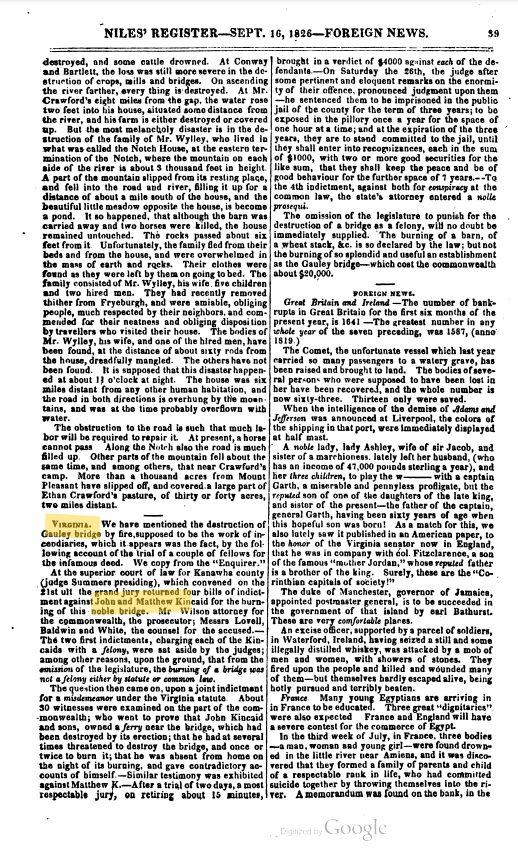
Sept. 16, 1826
Virginia. We have mentioned the destruction of Gauley bridge by fire, supposed to be the work of incendiaries, which it appears was the fact, by the following account of the trial of a couple of fellows for the infamous deed. We copy from the "Enquirer." At the superior court of law for Kanawha county (Judge Summers presiding), which convened on the 21st ult the grand jury returned four bills of indictment against John and Matthew Kincaid for the burning of this noble bridge. Mr. Wilson attorney for the commonwealth, the prosecutor; Messrs Lovell, Baldwin and White, the counsel for the accused. The two first indictments, charging each of the Kincaids with a felony, were sat aside by the judges; among other reasons, upon the ground, that from the emission of
the legislature, the burning of a bridge was not a felony either by statue or common law.
The question then came on, upon a joint indictment for a misdemeanor under the Virginia statue. About 30 witnesses were examined on the part of the commonwealth; who went to prove that John Kincaid and sons, owned a ferry near the bridge, which had been destroyed by its erection; that he had at several times threatened to destroy the bridge, and once or twice to burn it; that he was absent from home on the night of its burning, and gave contradictory accounts of himself. Similar testimony was exhibited against Matthew K.
After a trial of two days, a most respectable jury, on retiring about 15
minutes, brought in a verdict of $4000 against each of the defendants.
On Saturday the 26th, the judge after some pertinent and eloquent remarks on the enormity of their offence, pronounced judgment upon them----he sentenced them to be imprisoned in the public jail of the county for the term of three years; to be exposed to the pillory once a year for the space of one hour at a time; and at the expiration of the three years, they are to stand committed to the jail, until they shall enter into recognizances, each in the sum of $1000, with two or more good securities for the like sum, that they shall keep the peace and be of good behaviour for the further space of 7 years.
To the 4th indictment, against both for conspiracy at the common law, the state's attorney entered a 'nolle prosequi'. The omission of the legislature to punish for the destruction of a bridge as a felony, will no doubt be immediately supplied. The burning of a barn, of a wheat stack, & c. is so declared by the law; but not the burning of so splendid and useful an establishment as the Gauley bridge---which cost the commonwealth about $20,000."
**************************
The above newspaper report indicates that John and Matthew Kincaid served the time of their sentence in the Kanawha County jail, not in the city of Richmond in the Virginia State Penitentiary.